

I’m launching the A14 Strategy — a systematic weekly SPX campaign that begins around 14 days to expiration with a near-delta-neutral put Broken Wing Butterfly. Every entry, review, adjustment, execution, commission, and final result will be documented publicly.
A14 will become the flagship strategy of 10 Delta Playbook.
My directional 30 DTE Broken Wing Butterflies will continue as a separate trading system.
How I Got Here
Since July 2025, this publication has never been about one permanent strategy. It has become a public trading lab where I define rules, put structures to work, document the results, and change course when real evidence exposes a weakness.
🧪 My first major experiment was a weekly QQQ Bull Put Spread.
Over 25 weeks, I placed 24 trades. All 24 were profitable, producing a total net result of $11,597 with no losing weeks.
On paper, that looked nearly perfect. It also taught me the difference between a high win rate and a robust trading system.
The strategy regularly tied up about $25,000 to make roughly $500 per week. One violent Friday selloff in QQQ could erase a large portion of the accumulated gains—or, in the worst case, threaten the entire allocated account.
The risk was technically defined. The distribution of that risk was still unacceptable: many small wins against one potentially devastating loss.
I ended the experiment despite its 100% win rate. It had been traded in a paper account, and I was not willing to move it into real capital in its existing form.
🧪 At the same time, I was trading 10-delta credit spreads with real money.
I looked for stocks and ETFs showing extended price action, elevated RSI, and signs of momentum exhaustion. I would then sell a distant 10-delta spread—usually a Bear Call Spread after a strong rally.
The trade did not require me to call the exact top. The underlying could move slightly higher, stall, or reverse. It only needed to remain below the short strike through expiration.
The framework performed well for about nine months. I publicly documented 52 structured trades built around the same probability-driven process.
But low delta does not remove risk. It only moves that risk farther away.
MU made that clear in May. The stock continued far beyond the expected exhaustion zone, moved through both strikes, and the Bear Call Spread closed at maximum loss.
That loss did not invalidate the underlying market logic. Selling rich premium around an extended move with predefined risk still made sense.
The structure was the problem.
A short-duration vertical spread leaves little room for timing error. As expiration approaches, gamma accelerates and the position becomes increasingly sensitive to the underlying. If momentum continues longer than expected, there may be very little time—or flexibility—left to manage it.
🔄 That led to the next phase: moving from credit spreads to Broken Wing Butterflies.
I kept the original market logic but changed how I expressed it. Instead of using a narrow weekly vertical, I moved toward asymmetric Broken Wing Butterflies opened around 30 DTE.
The longer duration provides more time, a different risk shape, and less dependence on one expiration-day outcome.
I continue to trade and develop that framework. Depending on the setup, I can use calls or puts, typically placing the body near 20 delta.
But it is still directional.
Before entering, I must decide which move looks extended, where momentum may stall, and where I want the primary risk. A more flexible structure does not eliminate the original thesis. If the market continues hard enough against it, a Broken Wing Butterfly can still reach maximum loss.
My trading has therefore evolved through three clear stages:
a weekly QQQ Bull Put Spread with a perfect record but unacceptable tail risk;
live 10-delta credit spreads, where one maximum loss exposed the cost of directional asymmetry;
30 DTE Broken Wing Butterflies, which added time and improved the shape of the risk.
That progression led to a different question:
🤔 Can I build a core strategy that does not begin with a mandatory directional call?
Instead of searching every week for an overextended stock, I wanted a repeatable structure on a broad index—one that starts near neutral and responds to what the market actually does.
That search led me to A14.
What Is the A14 Strategy?
A14 is a short-duration, rules-based strategy traded with SPX options.
A new position is typically opened each Friday at roughly 14 DTE. The starting structure is a put Broken Wing Butterfly with defined initial risk and near-neutral delta.
But A14 is better understood as a campaign, not a single trade.
A complete campaign may include:
the initial Broken Wing Butterfly;
predefined management levels;
once-daily reviews;
upside or downside calendars;
adjustments to existing protection;
a profit target;
a mandatory exit plan.
The opening butterfly is only the starting point. The strategy’s real identity comes from how the entire position is managed as SPX moves.
A14 is not a passive butterfly opened and forgotten until expiration.
The Starting Put Broken Wing Butterfly
One put Broken Wing Butterfly uses four contracts across three strikes:
buy one upper-strike put;
sell two puts at a lower strike;
buy one additional put farther below the market.
The ratio is:
+1 / −2 / +1.
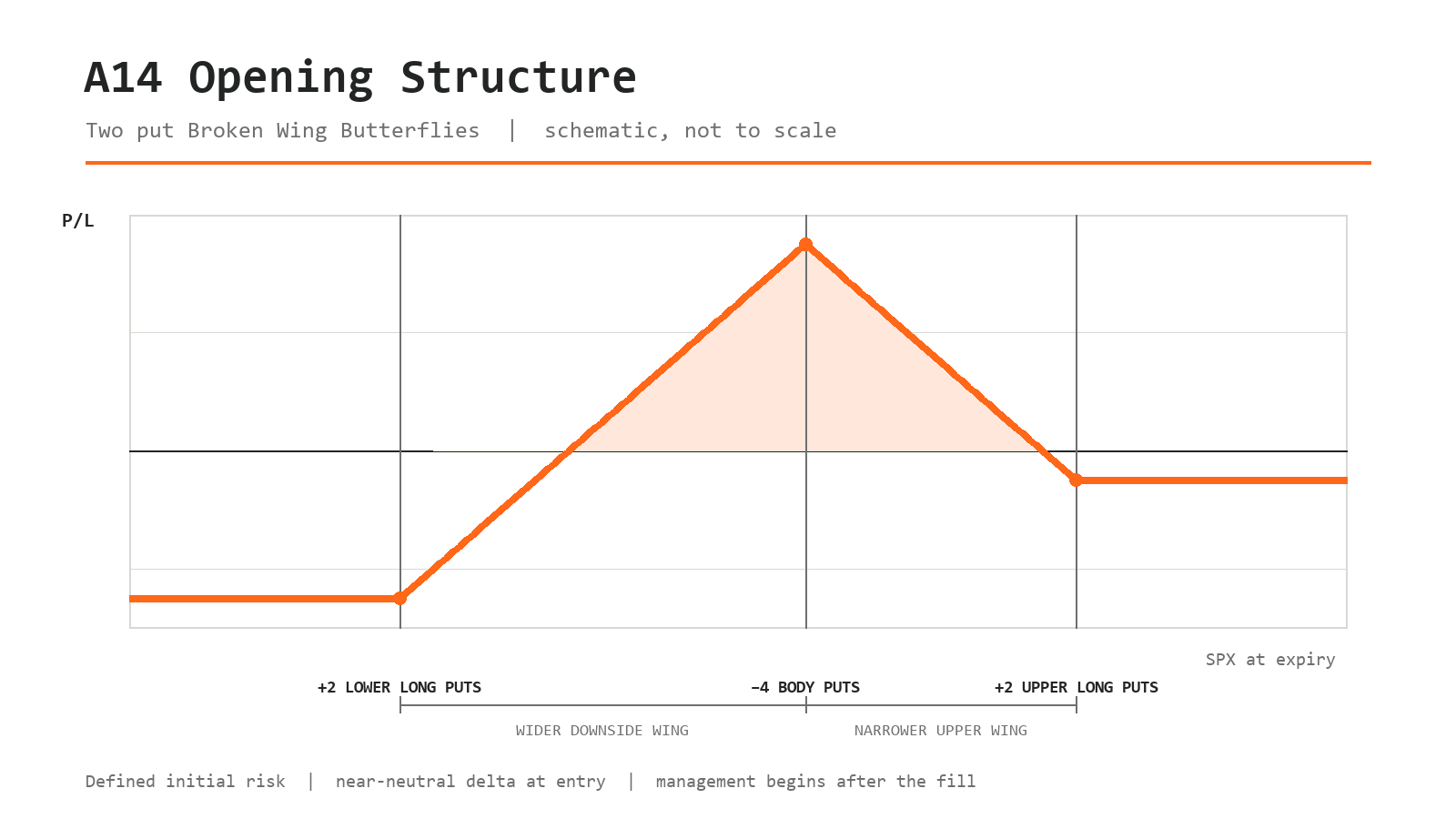
A standard butterfly has equal-width wings. A Broken Wing Butterfly deliberately makes one wing wider than the other.
That asymmetry changes the trade’s entry price, profit zone, directional exposure, and maximum risk.
My implementation begins with two butterflies:
+2 upper puts / −4 body puts / +2 lower puts.
The upper long puts sit near the current SPX level. The four short puts form the body below the market, while the two lower long puts define the downside risk.
I select the final strikes with the goal of starting near delta-neutral or slightly short delta.
That does not make the position risk-free. Delta is only a snapshot of current directional exposure. It changes as SPX moves, time passes, and implied volatility shifts.
A near-neutral start simply prevents the campaign from becoming a large directional bet at entry.
Why A14 Uses SPX
SPX options provide exposure to the S&P 500 Index rather than a single company.
They also have several practical advantages for a multi-leg campaign:
cash settlement;
European-style exercise;
no delivery of shares;
no early-assignment risk;
frequent expirations;
deep liquidity.
These characteristics are documented in the official Cboe SPX specifications.
For an actively managed structure, eliminating early-assignment and unwanted-share risk matters. I can focus on the full options position rather than worrying that one short leg may be assigned before the rest of the campaign is ready to close.
SPX is still a large contract. Defined risk does not mean small risk, and a two-lot A14 campaign requires sufficient capital and liquidity.
How A14 Handles Different Market Regimes
A directional trade starts with a forecast. The trader chooses a bullish or bearish thesis first and then selects a structure to express it.
A14 reverses that sequence.
The campaign begins near delta-neutral. Management decisions then respond to the actual location of SPX relative to the position.
Instead of repeatedly asking where the market will go next, I can ask more objective questions:
Where is SPX relative to the butterfly?
How has the campaign’s total delta changed?
Has a predefined management level been reached?
Does the rule set require an adjustment?
Is the likely benefit of that adjustment worth its cost and added risk?
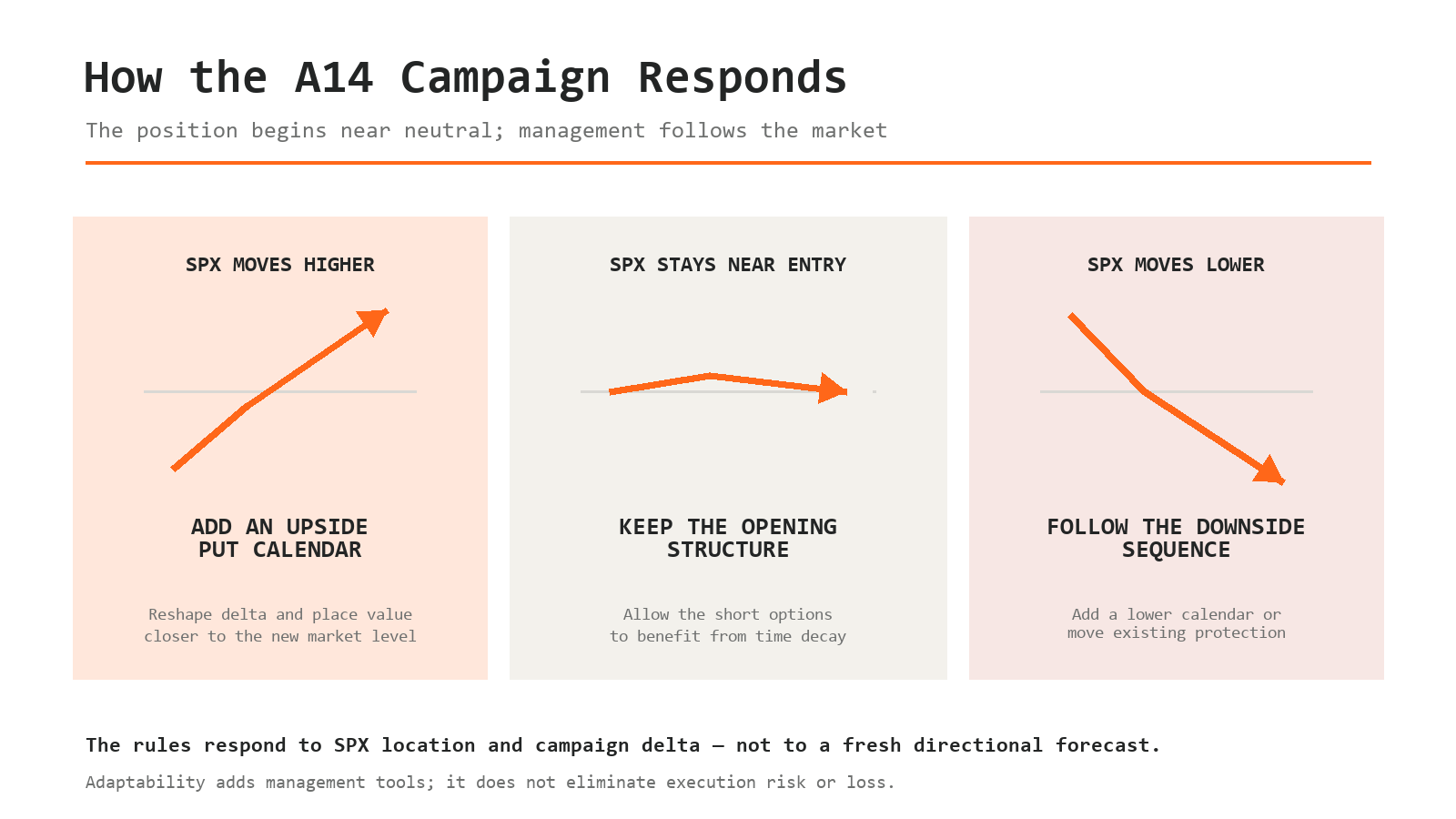
If SPX remains near the opening area, the short options can benefit from time decay.
If the index moves higher, an upside put calendar may be added to reshape delta and place value closer to the new market level.
If SPX falls, a separate downside sequence may add a lower calendar or move part of the existing protection into a later expiration.
This is why A14 is not tied to a permanently bullish, bearish, or sideways forecast. It begins near neutral and allows the position to evolve as the market reveals its direction.
That does not mean A14 “wins in every market.” No strategy does.
A fast move, volatility shock, poor execution, expensive adjustment, or sharp reversal after an adjustment can still produce a loss. Adaptability gives the campaign more tools; it does not eliminate risk/
Who Created A14?
A14 was created by options trader and educator Amy Meissner.
According to the published history, Amy began developing and live-trading the ideas behind A14 in September 2020. The strategy was publicly introduced in December 2021, with the original announcement still available through Aeromir.
Amy presents A14 as a weekly, market-neutral, fully rules-based strategy that generally requires one scheduled review per day.
Her official materials also report an approximately 85% win rate and a 229% net return during the original 15-month period.
Those are results reported by the strategy’s creator. They are not my results, an independent audit, or a forecast of what my implementation will produce.
The full proprietary A14 rules are sold through Amy’s educational programs.
As of August 2026, A14 Core is listed at a promotional price of $497, versus a stated regular price of $697. The A14 Complete package, including the advanced material and the first month of trade alerts, is listed at $997. Continued access to the alerts is offered at $129 per month after the first month.
That is a meaningful cost—especially for someone who does not yet know whether the strategy fits their capital, schedule, or risk tolerance.
I chose the research route.
Building My Own A14 Implementation
My objective is not to create a free copy of Amy Meissner’s paid course.
I do not claim to know or reproduce every proprietary rule in the original methodology. My implementation is based on Amy’s official public materials, open presentations, public trade examples, third-party research, and my own documented conventions.
One of the most useful primary sources is Amy’s publicly available 2023 A14 class presentation.
The public material establishes much of the strategy’s foundation:
entry at approximately 14 DTE;
a put Broken Wing Butterfly;
the general starting geometry;
neutral to slightly negative delta;
a defined profit target;
an upside adjustment using a put calendar;
several possible downside defenses;
an exit before expiration.
That is enough to understand the architecture, but not enough to produce a fully deterministic trading system.
Instructions such as “add a calendar if needed” or “move protection after a further decline” leave critical decisions undefined.
A systematic implementation needs exact answers:
What price level triggers the action?
When is the condition evaluated?
Which strike is selected?
How many contracts are used?
What happens after the first adjustment?
Can an adjustment be repeated?
When does management stop?
How are risk, profit, and commissions calculated?
I replaced those missing decisions with my own explicit rules and separated them from what Amy has disclosed publicly.
The accurate description is therefore:
This is an independently specified implementation based on the public A14 framework—not a claim that I have reproduced every proprietary rule of the original strategy.
My Initial A14 Setup
These are the operating rules at launch.
Underlying
Every campaign uses SPX options.
I am not automatically transferring the rules to SPY, QQQ, or individual stocks. Other underlyings have different contract sizes, exercise styles, liquidity, strike intervals, skew, and volatility behavior.
Entry Schedule
A new campaign is prepared every Friday at approximately 14 DTE.
I evaluate the opening structure around 10:30 a.m. New York time, after the first wave of opening volatility has passed.
If the option chain is stale, incomplete, or internally inconsistent, I will not force a trade simply because it is Friday.
A skipped campaign is better than a position built from unreliable data.
Position Size
The initial position consists of two put Broken Wing Butterflies:
+2 / −4 / +2 contracts.
Keeping the size constant allows me to compare campaigns without distorting the results through changing contract counts or compounding.
Strike Selection
The upper long put is selected near the current SPX level.
The short puts form the body below the market. The farther long puts define the wider downside wing and cap the initial risk.
The public A14 geometry serves as the starting point, but I choose the final structure using total position delta and executable market prices.
The objective is a liquid, reasonably priced position that begins near delta-neutral or slightly short delta.
Profit Target
The initial profit target is 5% of the modeled starting capital allocation after commissions.
That is not 5% of the entire account, nor is it 5% of the opening debit or credit. I use one consistent risk-based denominator so campaign results remain comparable.
If the target is reached, I close the campaign. I am not holding for the last theoretical dollar in the payoff graph.
Daily Review
The main position review takes place once per trading day, approximately 30 minutes before the close.
The review covers:
the current SPX level;
SPX relative to the campaign strikes;
the value of each position component;
total campaign delta;
any open calendars;
predefined management levels;
net P/L after commissions;
time remaining to expiration.
The goal is to remove constant intervention. I should not adjust the campaign simply because one intraday candle looks uncomfortable.
Upside Management
If SPX moves above the initial butterfly and meets the predefined conditions, I may add an upside put calendar.
For two opening butterflies, the adjustment uses one calendar:
sell one put in the front expiration;
buy one put at the same strike in the following expiration;
place the calendar near the market’s new location.
This is not a separate bearish trade. Its purpose is to reshape the campaign’s delta and add value closer to the rising index.
If SPX continues higher, the calendar may be rolled according to a separate rule.
Downside Management
A different sequence applies when SPX falls.
At the first downside management level, any existing upside calendar is closed and a lower put calendar may be added.
If SPX continues falling after that adjustment, part of the lower-wing protection can be moved into the later expiration.
The number of defensive actions is limited.
Each new leg adds cost, commissions, volatility exposure, reversal risk, and execution complexity. If the next adjustment is unlikely to improve the campaign materially, the correct action is to exit—not keep repairing the position indefinitely.
Final Exit
A14 is not intended to be held automatically through expiration.
The campaign closes when:
the profit target is reached;
a full-exit condition is triggered;
another adjustment no longer makes economic sense;
the mandatory time exit is reached.
My initial implementation will not hold a campaign beyond two days to expiration.
Gamma risk rises sharply near expiration. At that stage, a small SPX move can change the campaign’s delta and value quickly, making the remaining theoretical profit less attractive than a controlled exit.
How I Run Each Campaign
A14 is a multi-stage strategy. Opening the butterfly is only the first step; the campaign may later include calendars, rolls, defensive adjustments, and a coordinated exit across several positions.
I used Codex to turn my A14 research into a structured operating workflow. The system calculates the opening setup, freezes the management levels, tracks the current campaign state, monitors adjustment conditions, and keeps the net result updated as executions and commissions are added.
It does not place trades or make the final decision for me. I execute every order through my broker and remain responsible for every adjustment. The tooling gives me a consistent framework for running the same process week after week without rebuilding the campaign manually each time.

A14 vs. 30 DTE Broken Wing Butterflies
Both systems use Broken Wing Butterflies, but they are not the same strategy.
My 30 DTE Broken Wing Butterflies begin with a directional thesis on a specific stock or ETF. I evaluate the price structure and choose a call or put construction based on the setup.
A14 trades only SPX. It starts near neutral and follows a separate weekly management process.
One strategy expresses a directional view with a flexible payoff. The other is a repeatable broad-index campaign that does not require a directional forecast at entry.
Their trades, statistics, and conclusions will remain separate.
Questions I Had to Answer Before Trading A14
Is A14 completely market-neutral?
Only at the start, and only approximately.
The opening position is constructed near delta-neutral, but its exposure changes as SPX moves, time passes, and implied volatility shifts. A14 is better described as a near-neutral starting position with managed directional exposure.
Can A14 make money in every market?
No strategy can guarantee that.
A14 is designed to be managed through rising, falling, and sideways conditions. A fast move, volatility shock, poor fill, expensive adjustment, or sharp reversal can still produce a loss.
Is the risk defined?
The opening Broken Wing Butterfly has a calculable maximum risk.
A complete campaign may later include calendars and expiration changes. The risk profile must therefore be recalculated after every adjustment.
Does A14 require constant monitoring?
The core process uses one scheduled review per day.
My infrastructure may monitor the profit target between reviews, but management decisions are not meant to be made every few minutes.
Are these campaigns trade alerts?
No.
The public campaigns show how I trade A14 in real time. They are not trade alerts. Prices change, account sizes differ, and multi-leg SPX positions can move quickly. Anyone studying the strategy should test it in a simulated environment before risking capital.
Follow the A14 Strategy
I built a separate public dashboard for active and completed campaigns:
It will show the actual state of each campaign: opening structure, executions, daily reviews, adjustments, commissions, and final result.
Longer research articles and post-trade reviews will be published in the dedicated section:
This is not a signal service or an attempt to manufacture a flawless equity curve.
It is the next stage of 10 Delta Playbook: one systematic strategy, real capital, predefined rules, and a complete record of every decision.
The first public A14 campaign launches Friday, August 28, 2026.
All subscribers are invited to follow along—I welcome thoughtful questions and discussion as the campaign unfolds.
Disclaimer
All content is for informational purposes only and does not constitute financial advice. Any trades or strategies should be tested in a simulated environment before use. Trading involves risk, and all decisions are the sole responsibility of the reader.
Following. A bit complex to comprehend but will get there. I saw the second trade was placed at 11am instead of around 10:30, SPX moved from 7725 to 7710. 1. Did you see something that made you wait until 11 ? i would have expected a different strike selection at 11am. And do you also target certain debit amount ? Are my strikes assuming a 10:31 tarde time correct ? sorry for the long question
BWB Put
SPX SPOT Buy Sell Buy Debit
10:31AM 7724 7725 7685 7635 2.8
11:04AM 7710 7730 7690 7635 0.05
I’ve read about A14 before, but I’ve never seen someone publish the full campaign. This should be interesting to follow