

This position is closed.
Yes, it ended with a profit: +$398 net after commissions.
But this is not a victory post.
This is a breakdown of a trade that was structurally sound, technically explainable — and still deeply uncomfortable to live through. A trade that worked financially, yet failed in ways that matter more than P/L.
The Original Thesis
When I entered iShares Silver Trust (SLV) trade on January 12, silver had already gone vertical across all major timeframes. The move was no longer orderly. It was accelerating — emotionally, aggressively, and with growing public participation.
The intent was clear and explicit from the start:
this was not a call on a top.
The trade was designed as a momentum fade. A credit position positioned above the market, meant to benefit if upside acceleration cooled, stalled, or simply failed to continue at the same pace. No downside was required. No reversal was needed. Time and volatility normalization were supposed to do the work.
At the time, it felt reasonable to assume that SLV was entering an extreme zone — one where expectations had already been pulled forward and priced aggressively into call premiums.
That assumption turned out to be premature.

What Actually Happened
Instead of slowing down, SLV did what bubbles often do: it kept inflating.
Price pushed through all prior highs, cleared the psychological 100 level with ease, and continued higher into pure momentum territory, eventually peaking at 109.53. What initially looked like exhaustion was simply another stage of expansion.
This is where the first real mistake became obvious. ⚠️
I underestimated how long an “obvious” bubble can remain irrational — and how much further price can travel once it enters that emotional phase. Recognizing a bubble does not mean you can time its deflation.
The Trade Was Defined — But Not Comfortable
Structurally, risk was capped. The spread was defined. Nothing was broken from a mechanical standpoint.
But with 20 contracts, the size turned what should have been a probabilistic, detached credit trade into a psychologically heavy position. Large unrealized losses sat on the account while price kept pushing higher, and even though nothing forced an exit, the trade stopped fitting my mental risk profile.
This distinction matters.⚖️
Limited risk does not automatically equal acceptable risk — especially when the underlying is behaving in a way that invalidates the original character assumption of the setup.
The Hardest Part: Communication
This was the most uncomfortable aspect of the trade.😬
As SLV continued higher, I received questions and concerns from subscribers who trusted my judgment. And the honest truth is — I didn’t have a clean answer to give them.
Yes, SLV looked like a bubble.
Yes, upside expectations were extreme.
But no — I could not confidently explain when that excess would finally exhaust itself.
When you cannot calmly justify why you are still holding a position, that’s a warning sign. Even if the math still “works.”
The Exit
On January 30, I closed the position.
Not because expiration was near.
Not because maximum profit was achieved.
And not because the setup suddenly became invalid.
I exited because this was no longer my trade.
Could I have held until February 20 and potentially captured a much larger profit if SLV collapsed or stalled hard? Yes. Theoretically, the numbers supported that possibility.
But trading is not only about theoretical expectancy. It’s also about clarity, alignment, and mental capital.
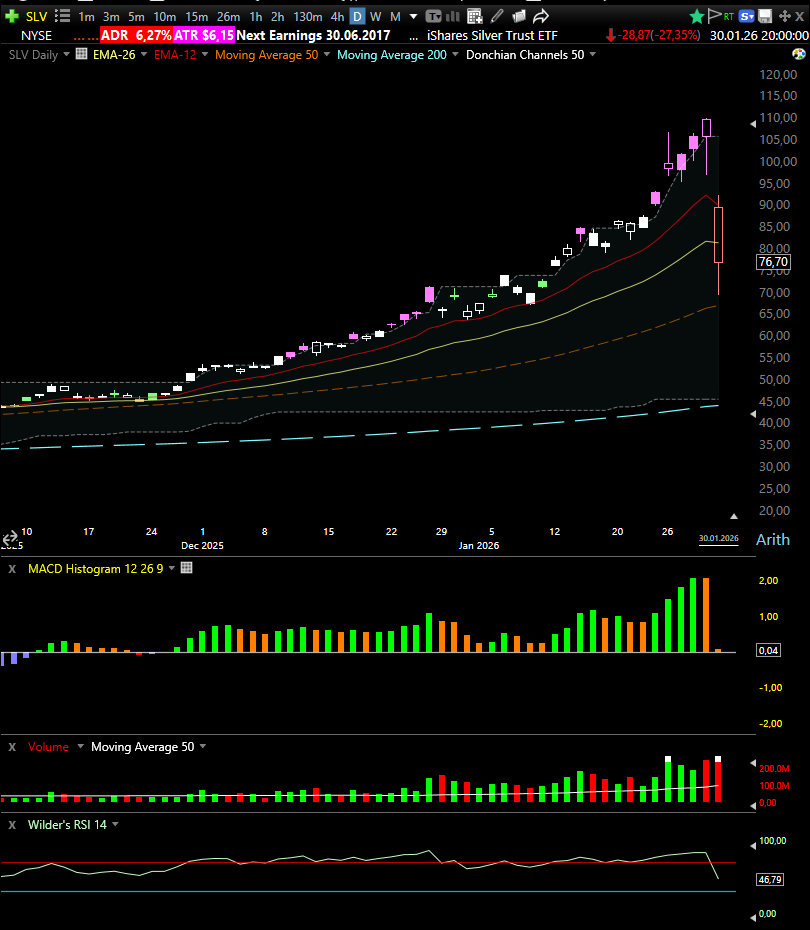
I chose to exit with +$398 net, even knowing I missed the absolute intraday low by a small margin. The relief of closing the position mattered more than squeezing every last dollar out of it.
Trade Recap
Underlying: SLV
Strategy: Bear Call Spread
Expiration: Feb 20, 2026
Structure: 84 / 88
Contracts: 20
Net P/L: +$398 (after commissions)
👉 View on OptionStrat
👉 View in Trade Log
Final Thoughts
This was a profitable trade.
But it was not a good one.
It violated my comfort zone, tested trust with my audience, and reminded me that being right about market excess is very different from being right on timing.
The most important lesson here is simple:
Profit does not automatically validate a decision.
Sometimes the real win is recognizing when a trade no longer fits — and having the discipline to step away, even in the green.
❤️ Support the Project
This Substack is free to read.
If you find value in the posts and want to support consistency,
you can do so 👉 by donating here 👈
Thanks for reading. Let’s build better trades.
Disclaimer
All content is for informational purposes only and does not constitute financial advice.Any trades or strategies should be tested in a simulated environment before use.Trading involves risk, and all decisions are the sole responsibility of the reader.
Thanks, Mansur. Yes, a few heart stopping moments on this SLV trade. When SLV was down 30%, I remembered this trade, and jumped to close it. The red had turned to green and I was glad to take it!
Yes, it was profitable but too stressful. On to the next one!
Well written and thank you for the transparency! I was very concerned for this position for you and am relieved you’re out unscathed — am on the other end myself, nearly closed my long positions but for various reasons paused and now am paying.