

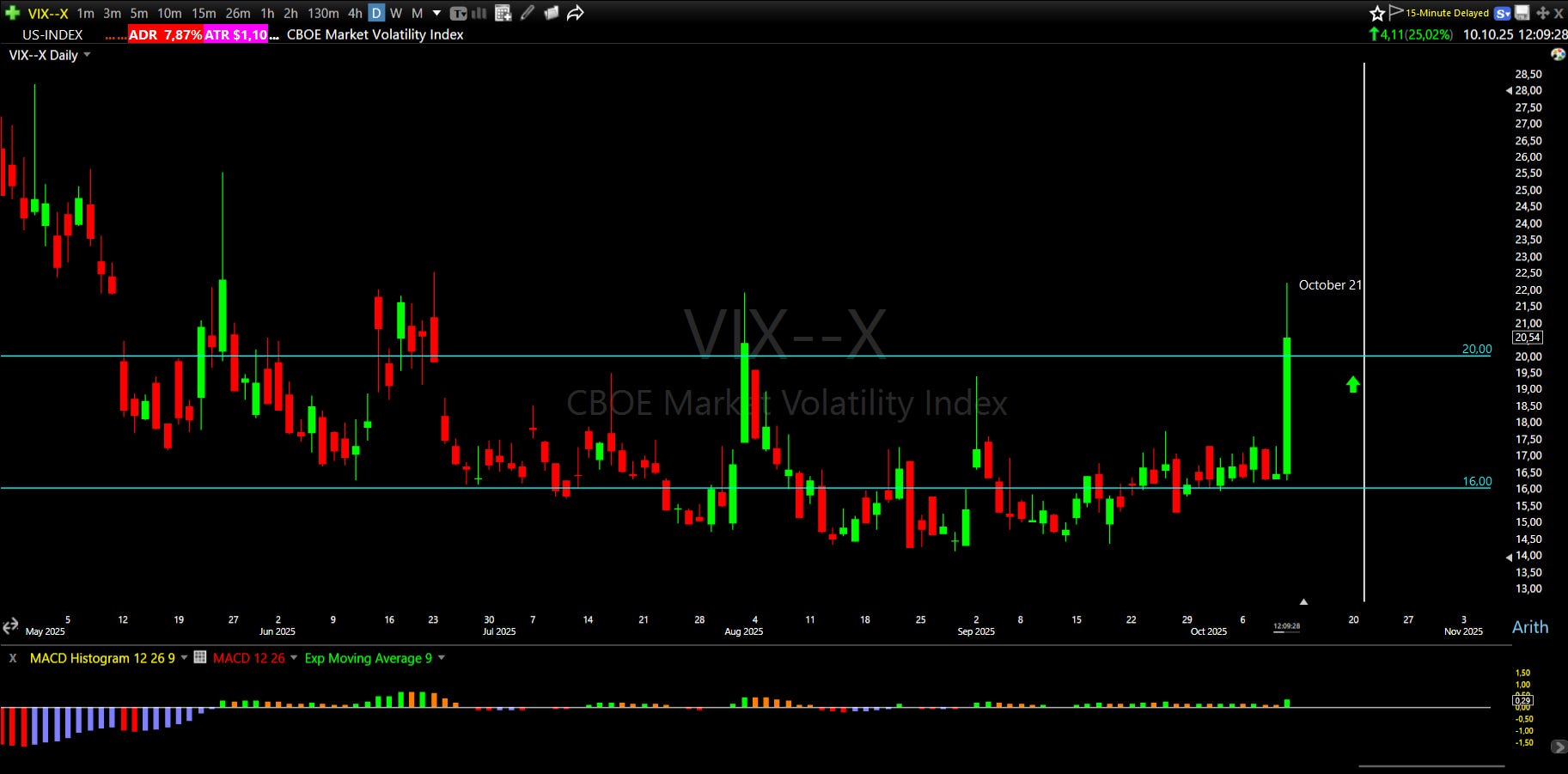
The October 1st government shutdown deadline passed without triggering immediate volatility. But the real spike came from an unexpected source: Trump’s sudden China tariff threat on October 10th.
VIX surged from subdued levels as Trump posted on Truth Social, accusing China of becoming “very hostile” with rare earth metal restrictions and threatening “massive tariff increases” on Chinese goods. Markets reversed sharply — the Nasdaq fell 2% from intraday all-time highs, the Dow dropped 579 points, and uncertainty flooded back into pricing.
The Bull Call Spread positioned for exactly this kind of binary shock — not predicting what would trigger volatility, but recognizing that geopolitical tension and deadline-driven uncertainty create conditions where fear spikes fast.
By Friday’s close, with VIX elevated and the 16/20 spread firmly in-the-money, I closed the position for a 109% return.
Trade Recap
Structure: Bull Call Spread (debit)
Expiration: Oct 21, 2025
Long Call: 16
Short Call: 20
Contracts: 4
Broker Fees: –$14.09
Net P/L: +$636
👉 View on OptionStrat
👉 View in Trade Log
Post-mortem
This trade tested a different angle: volatility expansion around binary risk events.
→ Initial setup anticipated October 1st shutdown deadline creating fear premiums — positioning early before implied volatility priced in the risk.
→ Shutdown was averted, but geopolitical uncertainty remained elevated through early October.
→ Trump’s tariff threat on October 10th triggered the exact volatility surge the structure was designed to capture.
→ VIX spiked sharply intraday as markets reversed from all-time highs — the 16/20 spread moved deep ITM within hours.
→ Closed Friday with spread value at $2.35, locking in over 100% return on capital in less than two weeks.
What Worked
Timing around binary events: Entering ahead of known uncertainty dates (shutdown deadline, APEC meeting) positioned the spread before implied volatility expanded. When unexpected geopolitical escalation hit, the structure was already live.
Defined risk on directional volatility: Unlike credit spreads where I sell premium expecting stability, this debit spread required directional movement — but capped downside at the net debit. Maximum loss was fixed at $452 regardless of how wrong the thesis proved.
Exit discipline: VIX trades are notoriously mean-reverting. Once the spread captured most of its theoretical max profit and fear premiums peaked, there was no reason to hold through potential volatility collapse. Closing Friday preserved gains rather than risking expiration decay.
Reflection
This was a departure from my systematic credit spread framework — a tactical debit spread betting on movement rather than against it. The thesis held: binary political deadlines and geopolitical tensions create explosive volatility conditions where VIX call spreads can deliver asymmetric returns.
But it’s not a repeatable weekly system like QQQ Put Spreads or 10-delta Bear Call Spreads. Volatility setups require specific catalysts, careful timing, and strict exit discipline. They’re tools for opportunistic scenarios, not consistent income generation.
The trade worked because the structure matched the environment: defined risk, clear catalyst window, and willingness to act when fear was underpriced. When uncertainty materializes faster than markets expect, volatility instruments respond violently — and that’s exactly what this spread captured.
❤️ Support the Project
This Substack is free to read.
If you find value in the posts and want to support consistency,
you can do so 👉 by donating here 👈
Thanks for reading. Let’s build better trades.
Disclaimer
All content is for informational purposes only and does not constitute financial advice.Any trades or strategies should be tested in a simulated environment before use.Trading involves risk, and all decisions are the sole responsibility of the reader.