

The Bear Call Spread on Johnson & Johnson (JNJ), opened on December 19 as a momentum fade, was closed today for a modest profit.
This exit was not driven by target fulfillment, but by changing conditions and calendar context — both of which matter as much as initial setup quality.
What changed
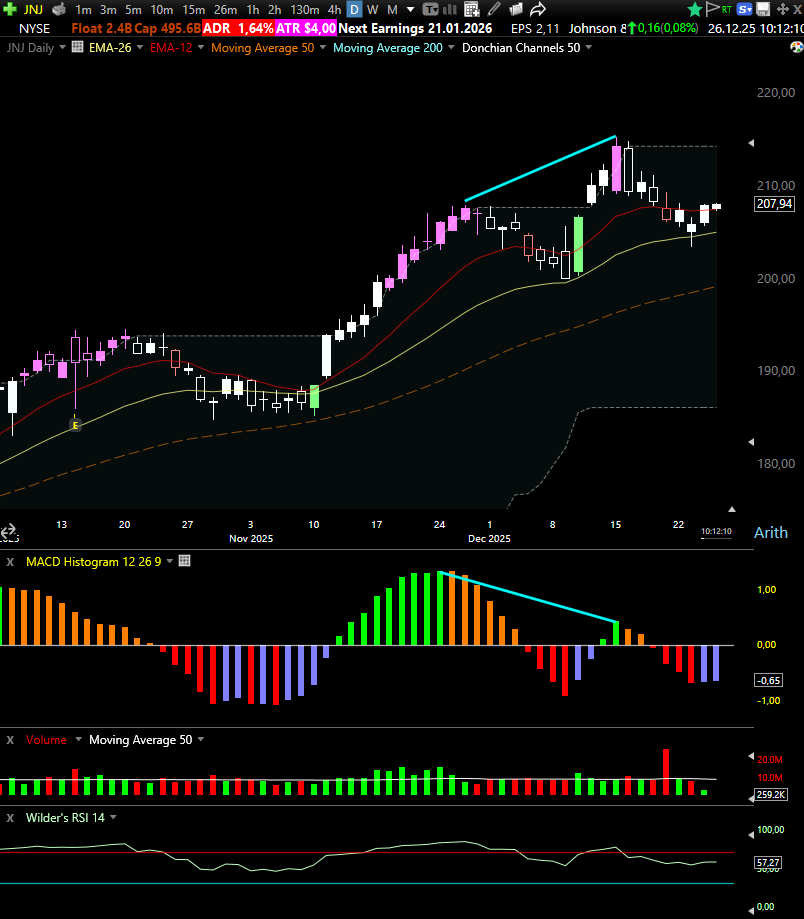
The original thesis was based on bearish MACD divergence after an extended advance, with the expectation of momentum cooling, consolidation, or a shallow pullback.
While the divergence remained technically valid, price began to rotate higher again, suggesting a short-term shift toward renewed upside attempts rather than clean digestion.
At the same time, two practical factors came into play:
The end of the trading week
The final full trading week of the year
Holding a fading setup into year-end with diminishing conviction was no longer attractive.
Why I exited
This strategy prioritizes clarity over stubbornness.
When a trade no longer aligns cleanly with the original intent — even if it’s still green — I prefer to step aside rather than wait and hope.
Capital efficiency and mental bandwidth matter, especially around holiday liquidity conditions.
This was a conscious decision to reduce exposure, not a reaction to fear.
Trade Recap
Structure: Bear Call Credit Spread
Underlying: JNJ
Expiration: January 23, 2026
Strikes: 205 / 210
Contracts: 5
Result: Closed early for a controlled profit
👉 View on OptionStrat
👉 View in Trade Log
Final note
Not every profitable trade needs to be maximized.
Sometimes the correct move is simply to acknowledge that the setup has lost its edge — and move on.
There will always be another trade.
❤️ Support the Project
This Substack is free to read.
If you find value in the posts and want to support consistency,
you can do so 👉 by donating here 👈
Thanks for reading. Let’s build better trades.
Disclaimer
All content is for informational purposes only and does not constitute financial advice.Any trades or strategies should be tested in a simulated environment before use.Trading involves risk, and all decisions are the sole responsibility of the reader.