

The discretionary Bear Call Spread on iShares Russell 2000 ETF (IWM), opened on December 22, was closed early today for a solid profit, well ahead of expiration.
While this trade was not part of my standard short-dated 10-delta framework, it followed the same core philosophy: fading upside acceleration once momentum begins to stall, and letting time do the heavy lifting.
What happened
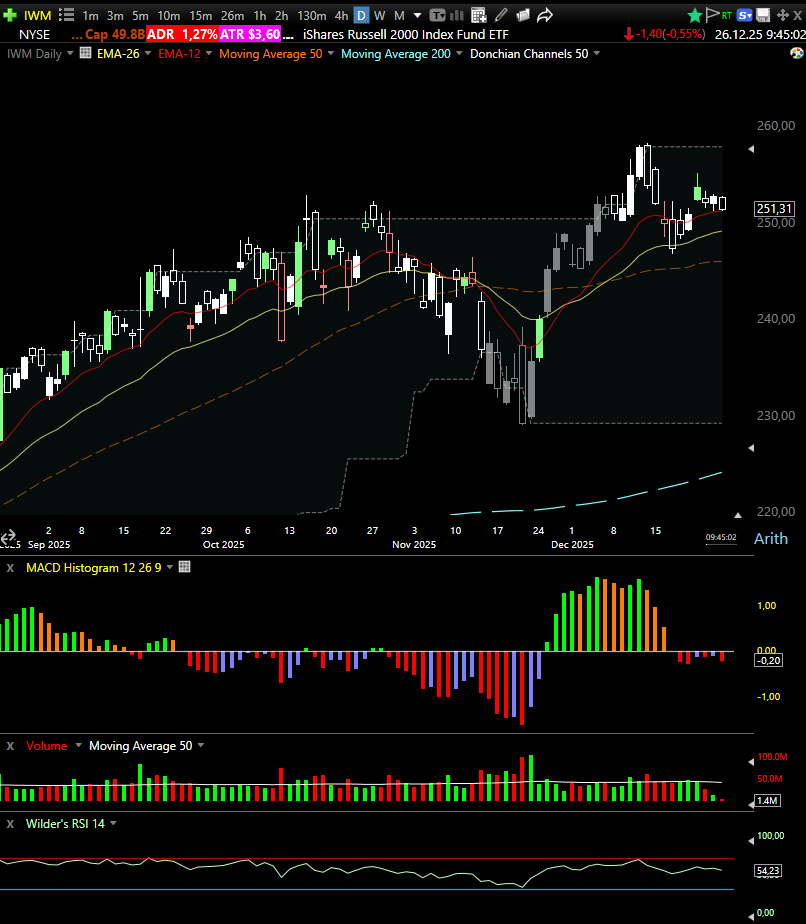
After a strong multi-week rally into year-end, IWM pushed into the upper end of its recent range. While price continued to hold firm, upside follow-through weakened, especially on higher timeframes.
Instead of breaking out with expanding momentum, price action shifted into hesitation and digestion. This was exactly the environment the trade was designed for:
not a selloff — just no aggressive continuation.
Over the following days:
Price remained comfortably below the 255–260 zone
Volatility stayed contained
Time decay steadily worked in favor of the position
By December 26, the spread had already delivered a meaningful portion of its maximum potential, making an early exit the optimal decision.
Why the early exit made sense
This trade was never intended to be held to expiration at all costs.
The primary goal was early monetization, aligned with my weekly income targets. Once that objective was reached, there was no reason to continue carrying exposure through the holidays and into potential year-end volatility shifts.
Locking in profit removes tail risk and frees capital for cleaner setups.
Trade Recap
Structure: Bear Call Credit Spread
Underlying: IWM
Expiration: January 23, 2026
Strikes: 255 / 260
Contracts: 10
Entry Credit: $2.30
Exit Prices:
Short 255 Call: 3.53
Long 260 Call: 1.78
Net Result: +$525 after commissions
👉 View on OptionStrat
👉 View in Trade Log
Final thoughts
This was a controlled, time-buffered momentum fade — not a directional bearish bet.
No breakdown was required.
No timing precision was needed.
Just a failure to accelerate higher.
That’s often enough.
Consistency in this strategy comes not from predicting direction, but from aligning structure, probability, and time — and being disciplined about taking profits when the market offers them.
❤️ Support the Project
This Substack is free to read.
If you find value in the posts and want to support consistency,
you can do so 👉 by donating here 👈
Thanks for reading. Let’s build better trades.
Disclaimer
All content is for informational purposes only and does not constitute financial advice.Any trades or strategies should be tested in a simulated environment before use.Trading involves risk, and all decisions are the sole responsibility of the reader.
Nicely done!✅