

From time to time I’ll publish notes like this — occasional deep dives into what I’m seeing across global markets. This is the first one.
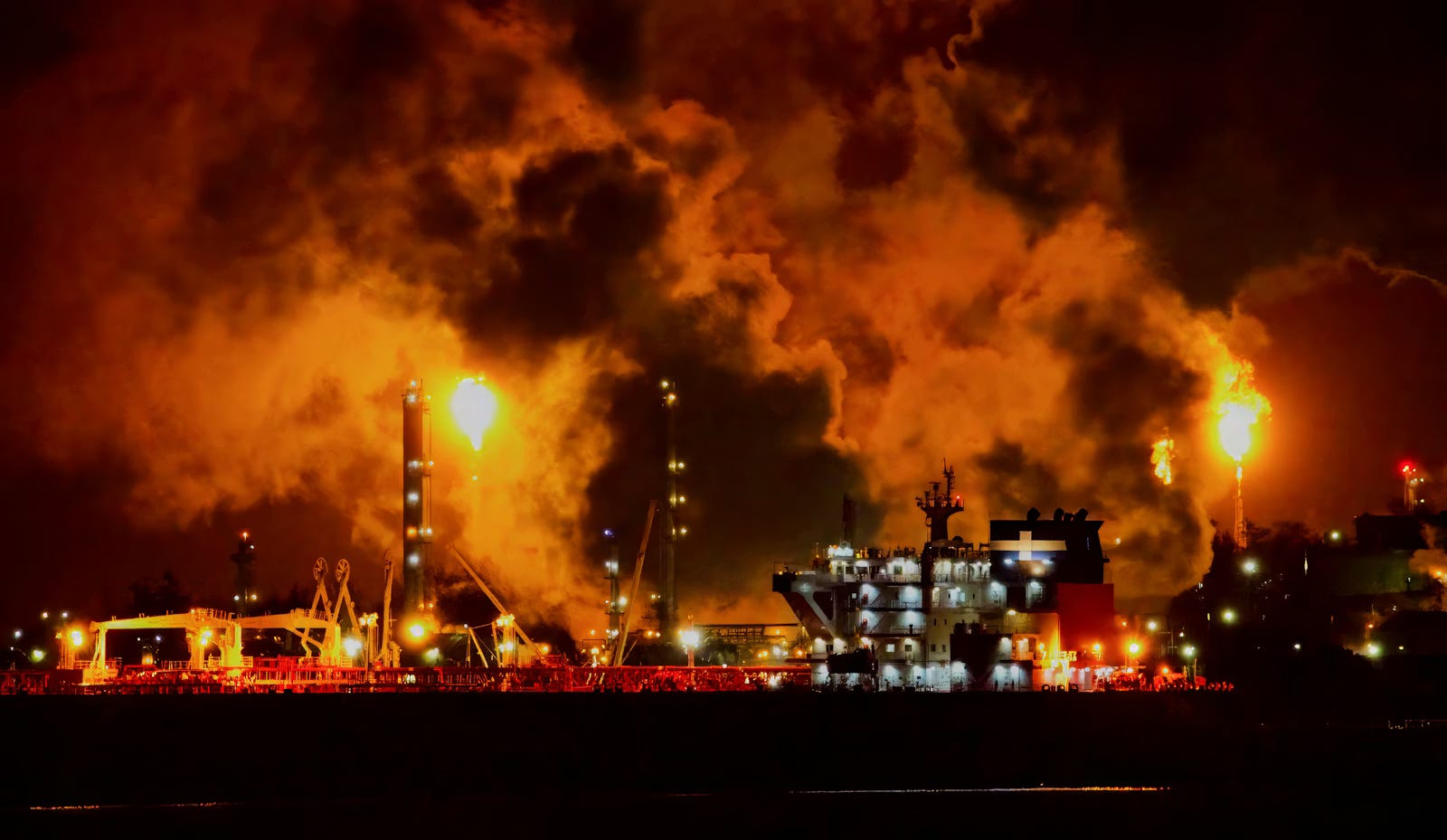
Sometimes the market stops being just a market. It becomes a field where geopolitics, liquidity, fear, headline velocity, and the very human inability to separate noise from a real inflection point all collide at once.
That is where we are now.
The core idea is simple, but important: markets do not live on headlines alone. They live on the interaction between liquidity, expectations, and price structure. News can accelerate a move. It can trigger stops. It can create panic. But durable decisions are not made at the moment of the loudest scream. They are made when it becomes clear what has actually changed in the machinery underneath.
And right now, several parts of that machinery are moving at once.
1. The central question is not war itself, but the price of its duration
The first and most emotionally charged topic is oil.
The market is not reading the escalation around Iran as merely a local conflict. It is reading it as a potential shock to global logistics. That is why the key question is not who struck first, or who appears to be winning the media cycle. The real question is whether the conflict remains short and manageable—or whether it becomes a prolonged disruption with real consequences for supply.
If the operation is brief, the market will likely respond with a sharp spike followed by normalization. But if tensions stretch out, and especially if the Strait of Hormuz comes under credible threat, oil stops trading as a temporary fear premium and begins to trade as a structural repricing.
In that kind of configuration, a move to extreme levels no longer looks theatrical. It becomes a rational extension of a shock regime: freight costs rise, insurance costs rise, routes become longer, and the cost of risk climbs across the entire energy system.
That is why energy assets cannot be judged right now with the usual lazy logic of “it’s overbought, so it’s time to sell.” In a geopolitical shock environment, overbought conditions often mark not the end of the move, but the first stage of panic repricing.
2. Why oil companies still look stronger than oil itself
There is an important nuance here: sometimes it makes more sense to read the reaction in large oil companies than in crude itself.
The logic is straightforward. When the commodity chart is full of noise and multiple possible interpretations, it can be easier to read the businesses that benefit directly from higher oil. In that sense, Exxon Mobil (XOM) acts as a cleaner proxy for the oil impulse.
The broader structure suggests that the initial impulse has already happened, the correction has lasted a long time, and the move may still not be finished. Yes, the parameters of the next phase are still uncertain: it may end up being short and climactic, or it may stretch into a much more extended final leg. But the larger point matters more than the exact path: the oil story likely has not finished playing out.
That leads to a conclusion that feels almost counterintuitive in real time: at the very moment when everyone wants to lock in gains, oil equities may still remain attractive.
3. For all the war noise, the macro backdrop remains risk-on
This is where the deeper part of the story begins.
Because if you get stuck only in the war narrative, you can miss the more important fact beneath it: global liquidity appears to be flowing back into markets.
That is the central pillar of the whole picture.
If global liquidity has already exceeded its 2022 highs, that is not a cosmetic detail. It is a signal that the system contains more money, more easing in financial conditions, and fewer signs of outright tightening than current sentiment would suggest.
It is crucial not to confuse economic mood with monetary regime. Mood can be anxious. Headlines can be catastrophic. But if:
rates are falling,
money supply is expanding,
major central-bank balance sheets are no longer acting as a purely destructive force,
and financial conditions are improving,
then markets still receive an underlying source of support for risk assets.
That is why the real takeaway is this: there is still no convincing sign of a systemic liquidity crisis.
And if that remains true, then even in a volatile tape, the base case for equities is not outright bearish. It remains constructive.

4. The one macro threat that cannot be ignored: Japan
Inside that broader constructive setup, there is one real fault line: Japan.
If Japanese bond yields become competitive—and especially if hedged returns begin to exceed U.S. yields—the global carry trade can begin to reverse. Capital that spent years searching for returns outside Japan suddenly has an incentive to move home.
It sounds technical. It is not.
This can become a meaningful pressure point for global flows. It does not have to trigger an immediate crash to matter. It only needs to begin changing the direction of capital.
Put simply: liquidity is still helping the market, but the Japanese bond market is one of the cracks worth watching closely.
5. The economy is weakening where it used to find support—but hyperscaler capex is still carrying the cycle
Another subtle but critical point is that the traditional parts of the economy look softer than they should, yet the market continues to hold up because of massive capital expenditure from Big Tech.
This is a very modern setup.
The consumer is not the main engine. Housing is not the main engine. The old industrial credit impulse is not the main engine. The cycle is being carried by hyperscalers—massive technology platforms spending aggressively on infrastructure, especially around cloud and AI.
The problem is that this kind of regime works only as long as the market believes those investments will eventually be monetized.
That is where the real differentiation inside mega-cap tech begins.
6. Amazon (AMZN): technically alive, fundamentally more troubling than it looks
The case on Amazon (AMZN) is fairly hard-edged: the stock may still have technical upside, but fundamentally it is becoming weaker than its peers.
The reason is free cash flow. It has compressed meaningfully. At the same time, capex continues to rise so aggressively that there is a credible path toward negative free cash flow in 2026.
That does not mean AMZN is a bad business. It means something more important: the market is paying for future growth, but the cost of that growth is becoming increasingly visible in present-day cash economics.
From here, the story is no longer about a grand AI narrative. It becomes a much simpler question: will these investments translate into faster revenue and earnings growth? If not, depreciation and the weight of capex begin to pressure EPS directly.
And that is exactly why the most dangerous stocks are not always the ones with weak businesses. Often they are the ones where expectations have outrun cash reality.
7. Microsoft (MSFT) and Alphabet (GOOGL): mature quality is back in demand
Against that backdrop, Microsoft (MSFT) looks close to exemplary.
Revenue has grown. Profitability has improved. Free cash flow has not collapsed. The business remains systemically embedded: subscriptions, enterprise software, cloud, infrastructure. This is not growth built on hope. It is growth still supported by a durable cash machine.
One of the strongest points here is that MSFT remains one of the rare companies above $300 billion in revenue that still fits the logic of the Rule of 40. That framework is usually applied to younger, faster-growing companies. Here, it is being met by a giant that is already woven into the structure of the global economy.
Alphabet (GOOGL) also looks very strong by comparison: similar cash-flow resilience, comparable valuation logic, and a high-quality core business. But at this moment, MSFT still appears to be the slightly cleaner and more comfortable way to buy strength.
That may be the central investment message in this environment: in a market full of overheated narratives, investors are once again paying for durability, predictability, and cash discipline.
8. Bitcoin (BTC): the most dangerous thing is not the decline, but the cycle

The Bitcoin view is most useful precisely because it avoids romanticism.
The idea is simple: the halving cycle still matters, the peak was likely already seen, and price now appears to be following a fairly standard post-peak path. That does not mean a straight collapse. Quite the opposite. There can still be strong reflex rallies ahead—rallies strong enough to convince a lot of people that the uptrend has returned.
That is exactly what makes this phase dangerous.
In this part of the cycle, markets often offer hope before they offer a bottom. A large countertrend rally into major resistance is entirely possible, but the broader direction still looks lower. A potential bottoming zone in the $25,000–$30,000 range is aggressive, but the framework is clear enough: do not mistake a technical bounce for a new cycle.
That is one of the most expensive mistakes in crypto.
9. Copper and gold: two very different expressions of the same world

Copper is a deficit story. Not a mood story. Not a narrative story. A real supply deficit story.
That is why the outlook remains bullish. The shortage can persist through 2026 and perhaps beyond. And that matters because copper is one of the best indicators not simply of industrial activity, but of future investment in infrastructure, electrification, grids, data centers, and the energy transition itself.
A copper thesis is not just a commodity thesis. It is a thesis on a capital-intensive future.
That is what keeps Freeport-McMoRan (FCX) relevant as one of the cleaner equity expressions of that trade.
Gold is a different kind of asset entirely.
There is no obvious sense of trend failure here. What exists instead is a sense of overheating inside a strong uptrend. In other words, the market is likely not done rising—it is simply digesting the previous impulse.
That is one of the best ways to read strong assets in the later stages of an uptrend: not by demanding a straight line higher, but by recognizing that a sideways phase inside strength is often a continuation of strength, not its negation.
For market participants using liquid instruments, SPDR Gold Shares (GLD) remains a useful proxy for that broader trend.
10. Silver (SLV): not a reason to panic, but a future accumulation zone
Silver is best understood as an asset that still needs to complete a new base after an extreme upside burst. It requires a fresh accumulation zone.
That is why the pullback should not be dramatized. It should be treated as a possible opportunity to build a more attractive long-term entry later.
This is a good example of mature thinking around volatility. When an asset explodes too far, too fast, the worst possible response is to chase it. The better response is to wait until the market builds a structure where risk and thesis line up again.
That is what makes iShares Silver Trust (SLV) potentially interesting again—but only after the chart has done the work.
11. Bonds and TLT: one of the rare ideas where protection and yield can coexist
One of the most practical parts of the whole setup sits in iShares 20+ Year Treasury Bond ETF (TLT).
The point is not that bonds must explode higher immediately. The point is that with the right options structure, it is possible to create an asymmetric parking place for capital: downside protection, dividend income, and participation in the upside if the move arrives.
This is not a beginner’s trade. But the logic matters.
In a world where cash yields something again, and bonds are no longer dead weight, the ability to structure yield becomes an investment edge in its own right.
That is what makes TLT interesting now—not only as a defensive asset, but as a more strategic one.
12. S&P 500 (SPX): there is a case for caution, but not for capitulation
The broader U.S. market still looks interesting for a simple reason: yes, there is accumulation happening near the highs, and that always raises the possibility of a pullback. But that does not automatically make the situation bearish.
A correction may happen. Better entry levels may appear. But the overall posture still leans more toward buying than toward retreat.
Why? Because inside the S&P 500 Index (SPX) there are already enough names sitting in strong technical and fundamental areas that waiting endlessly for a perfect setup becomes its own kind of risk.
That is one of the most honest conclusions in this whole picture. Not “I know exactly what happens next.” Not “the market must go up.” Something more mature: a correction is possible, but the quality of several setups is already high enough that total hesitation also carries a cost.
13. NVIDIA (NVDA): cheap on growth, still expensive in its right to disappoint
The most revealing ambiguity in the entire market may be NVIDIA (NVDA).
On one hand, the company can look cheaper than people assume if you focus on earnings growth. On the other, the market is still pricing it in a way that implies either growth never slows, or that any slowdown will somehow not matter.
That is a dangerous illusion.
The problem is not the quality of the business. The problem is that even a brilliant business, when priced against elevated expectations, becomes fragile at the first sign of cooling momentum. That is why caution makes sense here: technically, the structure still has not fully resolved, and the stock can still break lower—or resolve higher out of a larger consolidation.
That is not a rejection of NVDA. It is a rejection of overconfidence.
And that is the correct tone for the defining stock of this era.
14. What remains once the noise is stripped away
If all the market theater is removed, a few clean conclusions remain.
First: oil is now a function not of headlines alone, but of conflict duration and the risk of a logistics shock.
Second: global liquidity is not breaking the market right now. It is still supporting it.
Third: cash-flow quality matters again more than beautiful growth stories. That is exactly why Microsoft (MSFT) and Alphabet (GOOGL) look more convincing than Amazon (AMZN), and why caution on NVIDIA (NVDA) is justified.
Fourth: Bitcoin (BTC) likely has not completed its bearish phase, even if strong rallies appear first.
Fifth: commodities remain uneven—copper and gold still look strong, silver is building a base, and natural gas remains dangerous territory.
Sixth: the market as a whole does not look like a place where one should hide from everything at once. It looks like a place where one must distinguish much more rigorously between strength and fragility, liquidity and illusion.
That may be the central lesson of this moment.
Not to be the fastest. Not to outshout the news. Not to predict every detail.
But simply to learn how to distinguish between an asset that is rising because it has flow, regime, and momentum behind it—and an asset that is rising only because people still want to believe.
That difference is where results will be made in the months ahead.