

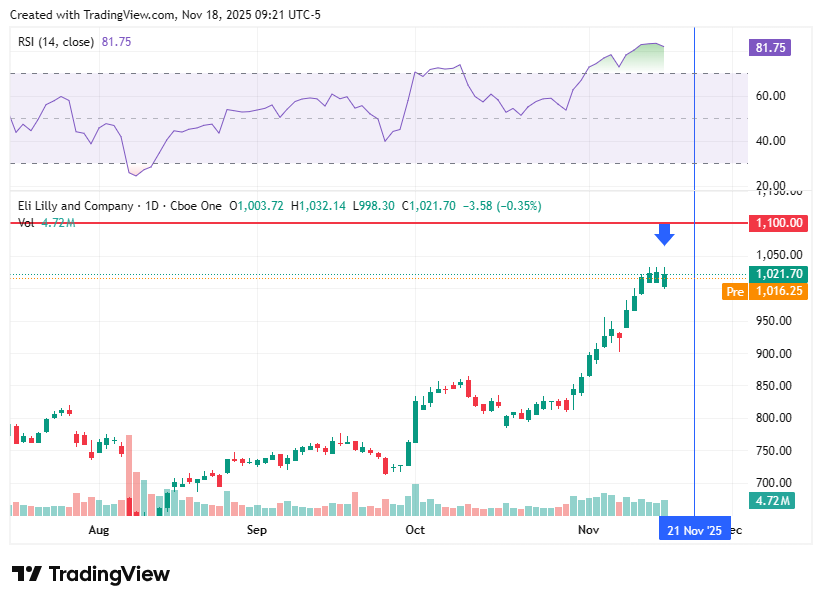
Eli Lilly and Company (LLY) is currently defining the term “parabolic,” surging into uncharted territory and closing Monday’s session near $1,021. The stock has been on a relentless vertical tear, distancing itself significantly from key moving averages. However, the technicals are flashing warning signs of exhaustion: the daily RSI has spiked above 81, a level rarely sustained by large-cap equities without a cooling-off period. The question: Can buyers maintain this vertical velocity, or is the rubber band stretched too tight, inviting consolidation before Friday’s expiration?
Setup Selection
This week’s chart reveals a classic climatic run: LLY pushing deeper into all-time highs, but with indicators suggesting the move is overextended. Daily RSI is currently reading an extreme 81.75, signaling deeply overbought conditions. While the price action remains bullish, the distance between the current price and the moving averages (EMA-12 and EMA-26) has widened to unsustainable levels in the short term.
Monday’s price action continued the ascent, but at these altitudes, buying pressure often dries up as profit-taking sets in. The MACD histogram is robust, yet when RSI exceeds 80, the probability of mean reversion or sideways consolidation increases significantly compared to continued vertical expansion.
My entry logic: This is a technical fade of an extreme move. I am not betting on LLY to crash or even reverse significantly; I am betting against the sustainability of this specific rate of ascent. The confluence of ATH resistance potential, extreme RSI readings, and the statistical rarity of sustained moves at these levels supports a fade. The 1100 short strike offers a massive buffer (~$79 above current price), requiring LLY to surge another ~8% in just four days to threaten the position.
Why Bear Call Spread?
Defined risk with capped downside exposure
Extreme RSI (81+) suggests imminent exhaustion or consolidation
Parabolic price action typically precedes sideways digestion
Profits from stagnation, consolidation, or decline—doesn’t require a crash
Wide safety margin with the short strike sitting near $1,100
The setup doesn’t demand LLY falls—only that it fails to rocket through $1,100 by Friday’s expiration.
Trade Structure
Expiration: November 21, 2025
Short Call: $1,100
Long Call: $1,110
Contracts: 13
Credit Received: $0.45 per contract
Maximum Profit: $585 (gross)
Broker Fee: -$18.20
👉 View on OptionStrat
👉 View in Trade Log
Entry and Exit Plan
The position was opened Monday, November 17. The short strike at $1,100 sits comfortably above the current all-time highs—a buffer designed to absorb continued volatility while maintaining a high probability of expiring worthless.
This isn’t a directional bet on a pharmaceutical collapse. It’s a fade of vertical continuation from historically overbought levels. The trade profits from consolidation, sideways action, or modest pullback—anything except a continued explosive move through $1,100 by Friday.
The plan is simple: hold through expiration and collect full premium. No early exits. Time decay does the work.
If LLY threatens the short strike with expanding momentum and volume, the position will be managed based on price action. But the setup is structured around that scenario being statistically unlikely given the current extension.
This week applies the framework of statistical reversion: high probability, defined risk, mechanical execution.
❤️ Support the Project
This Substack is free to read.
If you find value in the posts and want to support consistency,
you can do so 👉 by donating here 👈
Thanks for reading. Let’s build better trades.
Disclaimer
All content is for informational purposes only and does not constitute financial advice.Any trades or strategies should be tested in a simulated environment before use.Trading involves risk, and all decisions are the sole responsibility of the reader.